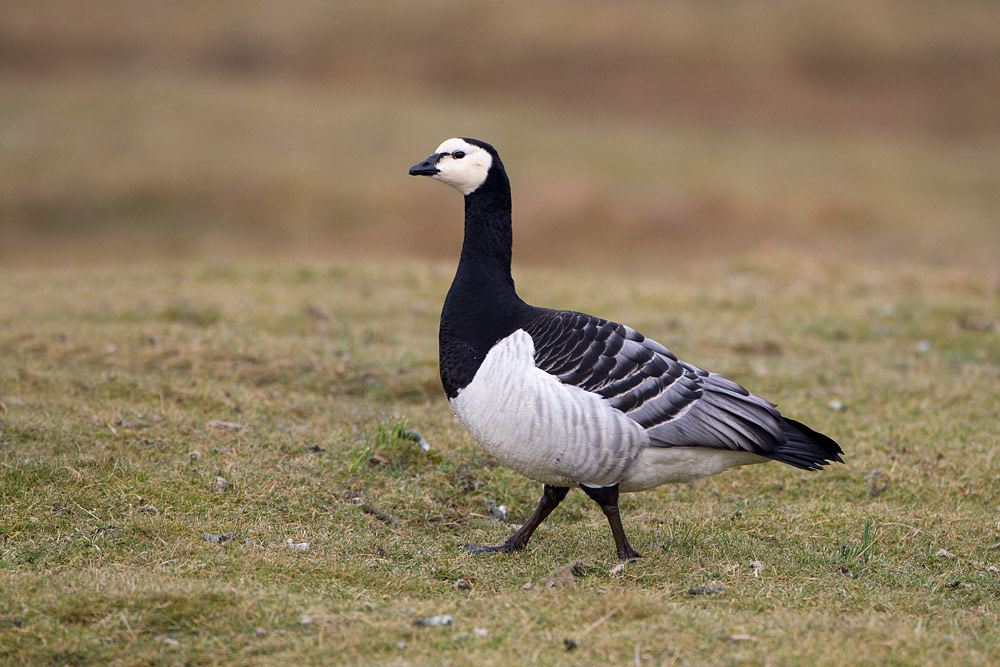
The Barnacle Goose is a medium-sized goose of the duck family found across Arctic and northern European regions. It is easily recognised by its striking black-and-white plumage, with a black head, neck and breast, contrasting white cheeks and pale underparts.
The back is grey with distinctive dark barring. The bill is short and black, and the legs are also dark. Males and females look very similar.
Barnacle Geese are migratory birds. They breed in high Arctic regions and move to the coasts of western and north-western Europe for the winter.
Key facts
Lifestyle
Barnacle Geese are highly social birds. Outside the breeding season, they gather in large flocks to feed and rest together.
Pairs usually remain together for many years. During the breeding season, they become more territorial and defend the area around their nest.
Nests are often built on rocky ledges, islands or steep cliffs. These inaccessible locations help protect eggs from Arctic foxes and other ground predators.
After breeding, the birds migrate in large flocks to their wintering grounds, where they feed on coastal grasslands, farmland and pastures.
Origin and distribution
The natural range of the Barnacle Goose is associated with the Arctic regions of the North Atlantic and Eurasia.
Major breeding areas include eastern Greenland, Svalbard, Novaya Zemlya and Arctic Russia.
Different populations migrate in winter to the United Kingdom, the Netherlands, Germany, Denmark and other areas around the North Sea.
In recent decades, some populations have also begun breeding farther south than their traditional Arctic range, including parts of northern Europe.