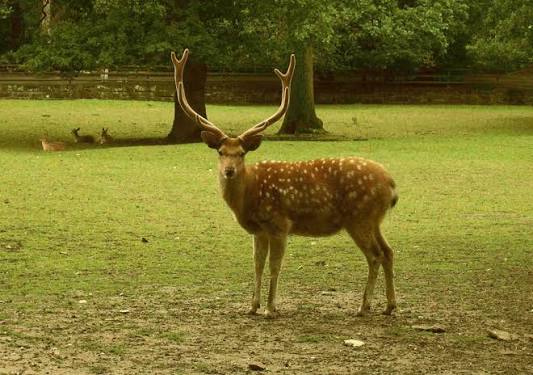
The Sika Deer is a medium-sized member of the deer family native to East Asia. One of its most distinctive features is the pattern of pale spots on its coat, which in many individuals remains visible even in adulthood.
During summer, the coat is usually reddish-brown with rows of white spots. In winter, the fur becomes thicker, darker and less contrasting. A prominent white rump patch bordered by darker fur is also characteristic of the species.
Males are larger than females and develop branching antlers, which are shed and regrown each year.
Key facts
Lifestyle
Sika Deer are most active around dusk and during the night. They are highly adaptable and can inhabit dense forests, open grasslands and mountainous environments.
Females often live in small groups with their young. Adult males are generally solitary for much of the year or may form small bachelor groups.
The rut takes place in autumn. During this period, males become territorial, leave scent marks and produce characteristic loud calls. Rival males may use their antlers in fights.
Sika Deer are strong runners, jumpers and swimmers and are capable of travelling considerable distances through water.
Origin and distribution
The natural range of the Sika Deer is in East Asia. Historically, the species occurred in Japan, China, Korea, the Russian Far East and other parts of eastern Asia.
Humans later introduced Sika Deer to many other regions. Today wild or free-ranging populations occur in the United Kingdom, Ireland and several other European countries, as well as New Zealand and North America.
In Japan, the Sika Deer remains one of the country’s most characteristic large wild mammals.