Main description
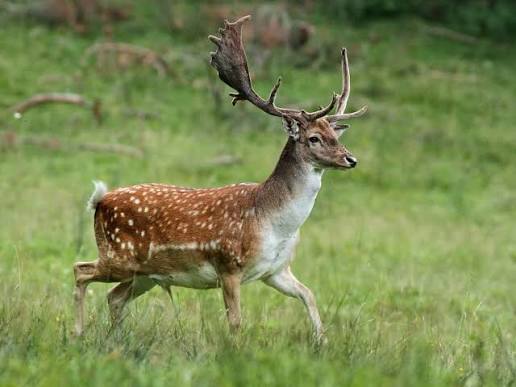
The European Fallow Deer is a medium-sized member of the deer family. It is easily recognised by its elegant body shape, characteristic spotted coat and the broad palmate antlers of adult males.
In summer, the coat is usually reddish-brown with white spots, while in winter it becomes darker and less contrasting. Very pale and almost black colour varieties also occur.
Fallow deer are highly adaptable and can live in deciduous and mixed woodland, grassland, shrubland, parkland and open areas close to forests.
Key facts
Scientific name: Dama dama
Family: Cervidae
Shoulder height: approximately 80–100 cm
Male weight: approximately 50–90 kg
Female weight: approximately 30–50 kg
Lifespan: around 12–16 years, but may exceed 20 years in captivity
Diet type: herbivore
Diet: grasses, leaves, young shoots, acorns, fruits and other vegetation
Habitat: woodland, grassland, shrubland and parkland
Conservation status: Least Concern
Male characteristic: broad palmate antlers
Lifestyle
Fallow deer are social animals. Females and their young often form herds, while adult males may live alone or in small bachelor groups for much of the year.
They are most active during the morning and evening. Fallow deer have excellent hearing, smell and vision, which help them detect danger quickly.
The rut takes place in autumn. During this period, males become more active, produce characteristic deep calls and compete with other males for access to females.
After the breeding season, the antlers are eventually shed and a new set begins to grow.
Origin and distribution
The historical origin of the European Fallow Deer is mainly associated with the eastern Mediterranean region and Anatolia.
Humans began moving fallow deer into different parts of Europe thousands of years ago. Their distribution increased greatly during ancient and medieval times.
Today fallow deer are widespread across many European countries, including Ukraine. They have also been introduced to North and South America, Australia, New Zealand and other parts of the world.