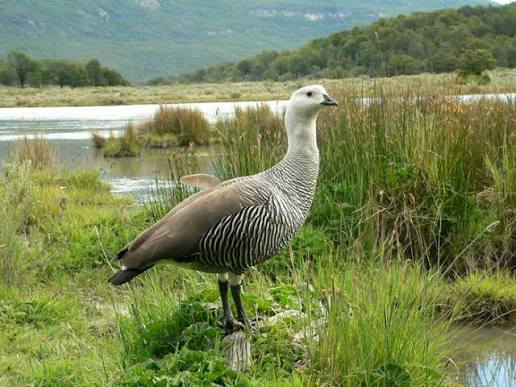
The Upland Goose, also known as the Magellan Goose, is a large member of the duck and goose family native to southern South America. The species is especially distinctive because males and females look dramatically different.
Males have a mainly white head and neck, pale underparts and bold black-and-white barring along the body. Females are much darker, with a reddish-brown head and neck, barred underparts and yellowish legs. The body length is approximately 60-72.5 cm.
Key facts
Lifestyle
Upland Geese spend much of their time on land, grazing in open grasslands and pastures. They may occur close to water but can also feed considerable distances away from it.
During the breeding season, pairs become strongly territorial. Nests are built on the ground, usually hidden among dense vegetation and often close to water.
Goslings leave the nest shortly after hatching and are able to feed themselves. Their parents protect them, and family groups may remain together for many months. In the Falkland Islands, breeding adults often return to the same territory and the same mate in successive years.
Origin and distribution
The natural range of the Upland Goose covers southern Chile and Argentina, Patagonia, Tierra del Fuego and the Falkland Islands.
There are two main subspecies. The mainland Chloephaga picta picta occurs in Chile and Argentina and is partly migratory, moving north during the colder season. The larger Chloephaga picta leucoptera is native to the Falkland Islands and is largely resident.
INTERESTING FACT