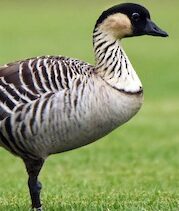
The Hawaiian Goose, also known as the Nēnē, is a rare goose species found naturally only in the Hawaiian Islands. It is endemic to Hawaiʻi and is one of the most distinctive birds of the archipelago.
The Nēnē resembles the Canada Goose. It has a black head, dark bill, pale cheeks and a characteristic neck marked with cream and dark horizontal stripes. The body plumage is mainly grey-brown.
Unlike most geese, the Hawaiian Goose spends much of its time on land and is particularly well adapted to walking across rocky volcanic slopes and hardened lava fields.
Key facts
Lifestyle
Hawaiian Geese are highly adapted to a terrestrial lifestyle. They are much less dependent on lakes and wetlands than most other geese and can survive in relatively dry environments.
Nēnē usually form strong pair bonds. A male and female may remain together for many years. During the breeding season, the female builds a nest on the ground, often among dense vegetation or in a sheltered location.
Goslings hatch well developed. Soon after hatching, they are able to walk and begin feeding on their own, although they remain with their parents for an extended period.
Nēnē are capable flyers, but they spend much of the day walking, grazing and searching for plant food.
Origin and distribution
The ancestors of the Hawaiian Goose reached the Hawaiian Islands hundreds of thousands of years ago. They are believed to have been related to the ancestors of the modern Canada Goose.
Long isolation on the islands led to adaptations in their feet, movement and behaviour, allowing them to thrive in volcanic environments.
During the twentieth century, the Hawaiian Goose came very close to extinction. Only a few dozen birds remained in the wild. Captive breeding programmes in zoos and conservation centres, followed by reintroductions, helped the species recover significantly.
Today Nēnē occur on several Hawaiian Islands, including Hawaiʻi, Maui, Kauaʻi, Molokaʻi and Oʻahu.