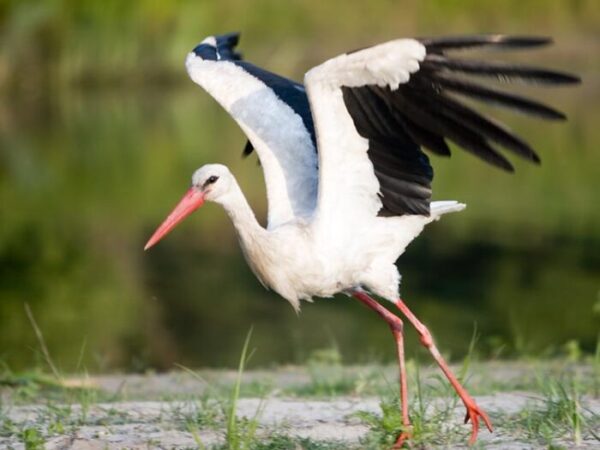
The White Stork is a large migratory bird of the stork family. It is easily recognised by its white plumage, black flight feathers, long red bill and long red legs.
White Storks often live close to people. Their nests can be found on rooftops, water towers, utility poles, specially built platforms and large trees.
The same nest may be reused for many years and is often repaired and enlarged each breeding season.
Key facts
Lifestyle
White Storks are mainly active during the day. They spend much of their time walking slowly through meadows, fields and shallow wetlands while searching for prey.
During the breeding season, storks form pairs. Males often return to the nesting site before females and begin repairing the nest.
Partners communicate with characteristic bill-clattering sounds. This behaviour is especially common around the nest.
Young storks remain in the nest for about two months. Both parents participate in feeding and caring for the chicks.
During migration, White Storks use rising columns of warm air. This allows them to glide for long distances while using relatively little energy.
Origin and distribution
The White Stork is widely distributed across much of Europe, North Africa, western Asia and central Asia.
In spring, the birds return to their breeding areas. In autumn, most populations migrate south.
Birds from western Europe mainly migrate through the Strait of Gibraltar into Africa. Storks from central and eastern Europe, including Ukraine, usually travel through the Balkans, the Bosporus and the Middle East toward eastern and southern Africa.
Some Asian populations winter in parts of the Middle East and South Asia.