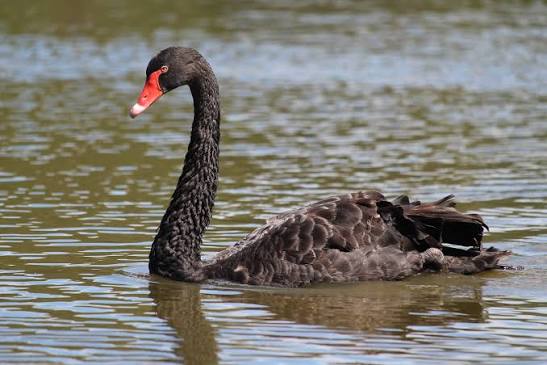
The Black Swan is a large waterbird of the duck family native to Australia and Tasmania. It is one of the most recognisable birds of Australian wildlife.
Most of the adult plumage is black, but the large flight feathers are white and are especially visible in flight. The bill is bright red with a pale band near the tip, and the long neck is often held in a characteristic S-shaped curve.
Males and females look very similar, although males are usually slightly larger.
Key facts
Lifestyle
Black Swans spend much of their time on or near water. They are excellent swimmers and use their long necks to reach aquatic vegetation growing below the surface.
Outside the breeding season, they may gather in large groups, particularly on wetlands with abundant food.
During the breeding season, Black Swans form strong pair bonds. Both parents help defend the nest and care for the young. Nests are usually built from reeds, grasses and other plant material in shallow water or on small islands.
Cygnets are covered in grey down and are able to swim with their parents soon after hatching.
Origin and distribution
The natural range of the Black Swan covers much of Australia and Tasmania. It is especially common in areas with large shallow lakes, wetlands and other permanent or seasonal water bodies.
The species has also been introduced to New Zealand and several other parts of the world. Black Swans are frequently kept on ornamental ponds, in parks and in zoological collections.
Wild populations may move considerable distances depending on rainfall and water levels. During droughts, birds can travel in search of suitable feeding and breeding habitats.